

Foreword:
Some time has passed since I first published the Halo article, so it felt appropriate to bring it to Substack before releasing the highly requested (and highly overdue) - Part Two.
The original article became available through Gumroad in August 2025. At the risk of sounding self-congratulatory, its publication catalysed a noticeable wave of Halo-related discussion on X.
I have since received a plethora of messages detailing individual user experiences with the compound. Needless to say, my theories were vindicated.
In the original halo article I suggested that a short, intentionally bounded androgenic state can be used as a calibration pulse to test reversibility of SSRI-induced anhedonia.
In those suffering from ‘depression’/anhedonia/burnout, the capacity for drive exists, it’s just buried
Power comes from within - those carrying this affliction have lost the ability to wield it
Strategic deployment of (specific) androgens provide a medium through which (buried) power can be realised
In the context of ‘depression’, engaging with traditional prescriptive therapies and/or SSRI’s have proven obsolete
The vast majority of young males who visit their physician seeking respite from depressive symptoms would benefit from access to androgen treatments.
Through the same mechanism, the compound (which can be extrapolated to cover wider ‘androgen’ therapies in general), can be leveraged in a number of areas.
One of those is cognition. Most ‘nootropic’ agents provide benefit only when the user has already satisfied the prerequisite condition of execution, or ‘beginning’. They (I’m generalising but this covers most mainstream nootropic agents) allow individuals to focus ‘better’ only when focus has already started.
But the bottleneck for most guys is almost always agency.
It is the stage of simply starting.
The gap between intention and execution is the real deficit.
And one of the most effective solutions (in my opinion) is a model of strategic androgen placement paired with specific ‘action based’ nootropics.
Men suffer when their actions do not reliably alter the world
I will continue to share my insights and theories on how you - and others, can improve your ability to shape reality.
PS - Regular substacks are returning. Part 2 is next.
(I had some extracurricular activities to take care of)
The Halo Effect
Lawrence Elliot. Aug, 2025
1. Initial disclaimer
Approach this framework with care. It is not a cycle recommendation for long-term use. It is an introductory manual framing an argument for personal exploration. Its central philosophy is to treat Halotestin as a probe, not a plan: a tool among many, growing more pertinent as society softens.
The purpose of a probe is diagnostic. You use it to test a system, gather information, and understand how it responds. Here, a short, highly structured, closely monitored exposure to a potent androgen receptor agonist pings the user’s masculine neuro-circuitry. The goal is signal detection: to establish whether those circuits are intact and capable of activation, map their response, and reveal latent potential for drive, assertiveness, and motivation.
This reframes the user from a passive consumer of a compound into an active, scientific self-explorer. The objective is to use the information gathered to guide a strategy for behavioural and physiological remodelling that does not depend on chronic use of a hepatotoxic oral steroid. That mindset governs both safety and efficacy.
Who is this guide for?
This is not for the casual user chasing simple muscle gain. It is for the man who wants more than average, who suspects he is capable of more but cannot yet see how or where it would show. Asking more of yourself is not self-punishment. We are all capable of more, and there is no reason to cap the quest for greatness. Perhaps you feel a fundamental disconnect from your masculine potential and have found conventional solutions inadequate. Or perhaps you are a little crazy, like me. Either way, the upside is real.
Standard testosterone replacement therapy (TRT), useful for many, is often insufficient for men with a deep masculine deficit. TRT restores serum testosterone to a normal physiological range but can fail to address downregulated androgen receptor density or sensitivity or suboptimal neurochemical programming from critical developmental windows. For these men, normalising serum levels does not reactivate circuits governing drive and assertiveness. A more potent catch-up stimulus may be required to resensitise those pathways.
2. What is Halotestin?
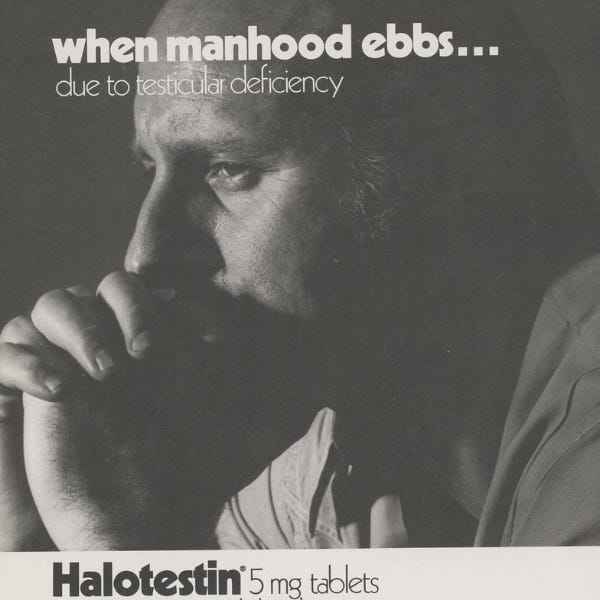
Fluoxymesterone, known by the brand name Halotestin, is a synthetic androgen and anabolic steroid first described in 1956 and introduced for medical use in 1957. It has a history of legitimate clinical application, which its reputation in bodybuilding lore tends to obscure. Approved uses include male hypogonadism, delayed puberty in boys, anaemia, and palliative treatment of androgen-responsive breast cancer in women. That history establishes it as a potent and serious tool built for real physiological intervention.
The pure androgen
Fluoxymesterone is an orally active, 17-alpha-alkylated derivative of testosterone. Three pharmacological features define its effects:
· Potent androgen receptor agonism. It binds the androgen receptor with high affinity, the same target as testosterone and dihydrotestosterone, and exerts a powerful androgenic effect.
· Non-aromatisable. Unlike testosterone, fluoxymesterone does not convert to oestrogen through the aromatase enzyme. This matters because the compound delivers a clean androgenic signal to the body and brain, unbuffered by the mood-modulating effects of oestradiol. With less serotonin-mediated inhibition, the environment stops closing in with worry.
· High androgenic-to-anabolic ratio. Its anabolic, tissue-building effects are moderate; its character is overwhelmingly androgenic, driving aggression, libido and central nervous system activation.
That profile makes it a rare instrument for exploring direct, unbuffered androgen receptor stimulation on the male psyche.
3. The masculine deficit
The 21st century presents a paradox. Amid unprecedented material comfort, a pervasive malaise, apathy and psychological stagnation afflicts a large share of the male population. The phenomenon is usually dismissed as a moral failing. It is more accurately a physiological state. We are living through a masculine deficit. Falling testosterone and declining sperm counts are the surface of it; beneath them lies a deeper collapse in will, drive and sovereignty.
A century ago, in Thus Spoke Zarathustra, Nietzsche diagnosed the condition. He described the last man as the creature that emerges at the end of history, the product of a civilisation that has prioritised comfort, safety and the elimination of suffering above all else. The last man blinks at the world, unable to face hardship or make meaning. He wants contentment, not greatness. He may dream of change and still remain in placid stasis. He is mediocrity made flesh, the antithesis of the will to power that Nietzsche took to be the engine of human achievement.
The psychological profile of the last man maps with uncanny precision onto the clinical phenotype of the under-androgenised male: apathetic, anhedonic, risk-averse, sexually blunted. Nietzsche had no access to endocrinology, yet he described the behavioural correlate of a body chemistry of resignation: blunted dopaminergic drive, impaired androgen receptor signalling, a system calibrated for passivity.
The modern masculine deficit is the physiological form of the last man.
Through a biological lens, the deficit is measurable. Men today show blunted dopaminergic systems, lower free testosterone and higher cortisol. Motivation is chemically throttled. Risk-taking is punished socially and hormonally. The result is passivity, depression and anhedonia.
The deficit also creates leverage. In a culture of weak men, the one who restores his masculinity stands out disproportionately, and becomes a leader, a competitor, a force. Restoring aggression and drive is therefore a strategic act, and the return on it compounds precisely because so few still bother.
Where in your life has a quiet decision to subdue aggression cost you an opportunity? Write down three. Then picture those moments answered with assertive action and measure the gap.
4. The second puberty
Puberty is more than a symbolic passage into adulthood. It is a neuroendocrine explosion that reorganises the male brain and body. Testosterone and its metabolites remodel neural circuits across the hypothalamus, amygdala, prefrontal cortex and hippocampus, and that remodelling drives sexual motivation, risk appetite and the emergence of identity.
When puberty is delayed, disrupted or blunted, whether by genetics, environment or modern endocrine disruptors, the transition never fully completes. The man arrested there becomes Nietzsche’s last man: a creature who prefers sedation to striving and safety to greatness.
The second puberty is a hypothesis grounded in neuroendocrinology. Exogenous androgens can reopen elements of adolescent-like plasticity, resetting the dopaminergic and limbic circuits that govern motivation and aggression. It deliberately induces that plasticity: restoring dopaminergic novelty-seeking, stripping serotonergic brakes, recalibrating stress coding, and remodeling the brain’s architecture of drive.
5. Halo versus testosterone
Testosterone is a broad, diplomatic androgen. It metabolises into oestradiol, which provides emotional smoothing and prosocial bonding, and into neurosteroids such as 3-alpha-androstanediol, which modulate GABA-A receptors to produce calm dominance.
Halo is a different animal. It is a militarised androgen: non-aromatisable, fluorinated, hepatically resistant, with strong androgen receptor binding and unusual effects on the stress axis. It sharpens circuits where testosterone balances them.
Testosterone builds authority through balance: dopamine drive, serotonin patience, GABA calmness, and oestradiol bonding. Halo builds sharpened aggression: dopamine without brakes, cortisol vigilance, serotonin suppression, and no GABA cushion.
Testosterone creates the king. Halo creates the warrior.
6. Cortisol: unlocking the MR pathway
Beyond its work as an androgen receptor agonist, fluoxymesterone carries a rare secondary mechanism that accounts for its distinct psychological signature: the inhibition of a critical enzyme, 11-beta-hydroxysteroid dehydrogenase type 2 (11-beta-HSD2).
Start with the mineralocorticoid receptor (MR). Found in the kidney and in brain regions such as the hippocampus, the MR responds to both aldosterone and cortisol. Cortisol circulates at 100 to 1,000 times the concentration of aldosterone, so a protective mechanism is needed to stop it constantly overwhelming the receptor. That protection is the 11-beta-HSD2 enzyme, which rapidly converts active cortisol into inactive cortisone at the receptor site.
Research has shown that fluoxymesterone is a potent, competitive inhibitor of human 11-beta-HSD2. By disabling that enzymatic shield, it lets far more local cortisol remain active and bind the MR.
This MR-mediated pathway is the direct biological link between the compound and the philosophical aim. MR activation in the limbic system modulates stress appraisal, vigilance and decision-making, biasing the organism toward rapid, decisive, approach-over-avoidance behaviour. Fluoxymesterone therefore induces a state of heightened readiness, sharp focus and proactive engagement: the physiological foundation for the posture of command and agency that defines the Übermensch ideal.
There is a cost written into the mechanism. Inhibiting 11-beta-HSD2 temporarily raises cortisol’s signal throughout brain and body. It can feel like amplified readiness, aggression, and dominance, but physiologically it is a stress mimic and carries a heavy cardiovascular and psychological toll. This is why the compound belongs in short bursts.
7. Neuro-perceptive remodelling
Halo does something stranger than raising neural and physical drive: it changes perception of the world itself. Users describe their environment as feeling more spacious and themselves as newly able to enact their will upon it. This is not hallucination. It follows from the activation of specific neural substrates and is best described as a modulation of affordance.
In psychology, an affordance is what the environment offers you. A chair affords sitting, a door affords opening. Perception is action-oriented; the brain encodes space in terms of what you can do with it.
· Parietal cortex. This region computes object affordances. Dopamine and noradrenaline tone here strongly modulate whether space feels constricted or expanded. Halo increases affordance tagging, turning objects into actionable opportunities.
· Hippocampus. Androgen receptors are present in hippocampal areas CA1 and CA3, and androgens increase dendritic spine density and synaptic plasticity. Under Halo, hippocampal networks bias toward proactive navigation and a sense of expanded environment.
· Amygdala. The amygdala decides whether ambiguity is threat or opportunity. Testosterone biases it toward approach; Halo’s androgen and MR crosstalk exaggerates the shift, turning ambiguity into challenge.
Together these effects transform the user’s relationship with the environment. The brain reads the openness of the world as a direct consequence of its own capacity to act. Fluoxymesterone biases the brain to perceive space as a canvas to be commanded.
Human psychology is not static. It is shaped by selection pressures that reward some behaviours and punish others. In the ancestral environment, adolescent surges of androgens recalibrated male cognition toward aggression, competition and risk-taking. Fluoxymesterone resurrects that developmental crucible in adulthood. It is a re-enactment of the evolutionary forces that sculpted masculinity, not merely a drug state.
The implications reach into self-authorship.
Identity is usually treated as a discovery, the process of finding one’s authentic self.
Construction is the more accurate model: a man defines himself by what he chooses to enact. Intervening pharmacologically is therefore an act of authorship, using biochemical tools to force an encounter with capacities that would otherwise lie dormant.
History shows the reach of the principle. Consider Mike Tyson. Few figures in modern sport embody aggression as vividly, and during his peak years Tyson is reported to have used fluoxymesterone in training and competition. The irony is sharp: the most feared heavyweight in boxing, already defined by explosive violence, linked to a drug that amplifies exactly those traits. Was his dominance purely innate, or catalysed by the pharmacological amplification of androgenic circuitry? A man already built for violence still went looking for more. Whatever Halo gave him, his nature had not.
Another example - John F. Kennedy. His medical history records fluoxymesterone administered as part of his treatment for adrenal insufficiency. Kennedy is remembered as magnetic, decisive and commanding, a man who projected vitality from a body plagued by chronic illness. It is reasonable to propose that fluoxymesterone contributed. By stripping hesitation, raising vigilance and sharpening dopaminergic drive, it may have supported his ability to deliver speeches with conviction, handle crises with clarity, and radiate authority. Seen this way, fluoxymesterone is the androgen of the leader as much as the androgen of the fighter: the same molecular signature that produces readiness for combat can underpin the presence required to govern.
These cases reveal the true scope of the compound. It is not confined to sport or aesthetics. It amplifies the male role itself, in combat, in politics, in any arena that demands decisiveness and command. The archetypes of warrior and king are not abstractions; they are neuroendocrine states enacted under pressure. Fluoxymesterone exposes how thin the boundary is between biology and myth.
In evolutionary terms, the drug reactivates pathways that modern comfort has muted. In philosophical terms, it exposes identity as malleable, constructed and open to radical revision. The man who undergoes the state faces a choice: dismiss it as chemical illusion, or accept it as evidence that his prior self was a fraction of what is possible. The second is the path of self-creation, a step toward becoming more than one was, taken through physiology.
8. Deconstructing the myths
The potency of fluoxymesterone has bred folklore inside performance-enhancement communities. Three myths deserve dismantling.
Myth 1: Halotestin is roid rage in a pill. Roid rage is an oversimplification. The psychological state is a complex shift toward dominance-seeking behaviour and reduced serotonergic inhibition. In an undisciplined man it can surface as irritability. Channelled through discipline and a clear objective, it becomes command presence: focused, assertive, decisive. The compound supplies the raw potential; the user’s character decides its expression.
Myth 2: It is purely for strength and has no real anabolic effect. Its reputation is overwhelmingly androgenic, but it does carry moderate anabolic properties. Its historical use in treating anaemia points to its stimulation of red blood cell production, which supports endurance. Within this framework, though, its value is neurological.
Myth 3: It causes a complete and irreversible HPTA shutdown. At typical bodybuilding doses, largely true. A pivotal 1977 study of low-dose fluoxymesterone in boys with delayed puberty revealed a more complex picture: plasma testosterone was suppressed, yet luteinising hormone (LH) and follicle-stimulating hormone (FSH) were not significantly altered. The researchers proposed a local effect on the testes, independent of pituitary signals. That suggests the effect on the HPTA is dose- and context-dependent, and it opens a theoretical case for strategic, low-dose use as a short-term probe that could mitigate the risk of full shutdown.
9. Further applications
Utility in post-finasteride syndrome?
The existence of the condition is debated. In theory, Halo could have utility in its dissolution, since PFS involves potential androgen receptor dysregulation, neurosteroid deficiency and dopaminergic blunting.
· AR dysregulation. Halo superactivates androgen receptors, potentially bypassing some receptor desensitisation.
· Neurosteroid deficiency. Halo cannot restore missing neurosteroids, though it may compensate through overwhelming dopaminergic drive.
· Dopamine reawakening. Halo’s androgen-driven dopamine potentiation may restore initiative, libido and motivation.
10. Acknowledging risk
Halo presents real risks: hepatotoxicity, cardiovascular strain, psychiatric volatility. It is a powerful tool that can be wielded as a sledgehammer or as a scalpel. Both have their place; both demand conscious handling. If you were to go about this, hypothetically, do it under the guidance of a medical professional, or better still, someone who actually knows what they are talking about. Enquire here for personal coaching (shameless plug).
11. Conclusion
The choice of an androgen is the choice of a precise neurochemical tool for a specific psychological outcome. Halo’s profile is a specialist’s instrument: it sacrifices the broad-spectrum, socially buffered effects of testosterone for a sharp, focused, high-intensity state of vigilance and agency.
Halotestin can act as a catalyst for identity change. When a man experiences himself at full capacity, decisive and unrestrained, that experience becomes a benchmark, and it changes how he sees himself long after he stops. Once you have watched yourself operate at a higher level, the old frame of limitation no longer fits.
The modern world is hostile to powerful men. It prefers them sedated, compliant and distracted. This guide is a philosophical, psychological and neurochemical exploration of what Halo represents, and it concerns sovereignty as much as receptors and pathways.
The frame of the Biowinner is to treat the world as his arena and to bend fate with will. Halo is a case study in what happens when a man reclaims his power and steps into that frame.
12. Legal and medical disclaimer
This guide is provided for educational, informational and hypothetical purposes only. The content is a theoretical exploration of pharmacology, neurochemistry and philosophy. It does not constitute, and should not be read as, medical advice, diagnosis or treatment.
The author and publisher are not medical professionals. Consult a qualified and licensed physician or other healthcare provider before making any decision or change to your health, diet, lifestyle or exercise regimen. Do not disregard professional medical advice, or delay seeking it, because of anything you have read here.
Fluoxymesterone (Halotestin) is a potent pharmaceutical drug and a controlled substance in many jurisdictions. The misuse of anabolic androgenic steroids carries significant and potentially irreversible health risks, including but not limited to liver damage, cardiovascular disease, endocrine disruption and adverse psychological effects. This guide does not endorse, encourage or recommend the use, purchase or acquisition of fluoxymesterone or any other controlled substance.
The author and publisher assume no liability for any action taken by the reader. By reading this guide, you agree to hold the author and publisher harmless from any and all claims, losses or damages arising from your use of, or reliance upon, the information presented here.
13. Legal status
· United Kingdom. Fluoxymesterone is a Class C drug. Under UK law it is legal to possess anabolic steroids for personal use, but illegal to supply or sell them to others. Importation or exportation for personal use is permitted only if carried out in person; sending or receiving them by post or courier is illegal.
· United States. Fluoxymesterone is a Schedule III controlled substance under the federal Controlled Substances Act. Possession without a valid prescription is a federal crime, and penalties can be severe and vary by state.
This guide is framed to operate within these legal and ethical boundaries. The project is an educational and hypothetical framework. At no point does it provide sourcing information, specific dosing recommendations, or direct encouragement to acquire or use a controlled substance.